


Home · Where is Izmir · Ephesus
Day trips from Izmir
Ancient City of Ephesus, a day trip from Izmir
Ephesus is an ancient Greek and Roman city near Selçuk, about 80 km south of Izmir and around an hour by car. Its marble streets lead past the Library of Celsus and the Great Theatre. A visit takes two to three hours, on uneven ground with little shade.


 Patient service award three years running · Licensed for health tourism
At a glance
Ephesus from Izmir, in brief
- about 80 kmSouth of central Izmir, near Selçuk
- around 1 hourBy car from Izmir
- 2–3 hoursFor the main site on foot
- UNESCOWorld Heritage Site since 2015
What is the Ancient City of Ephesus?
Ephesus was founded by Greek settlers on the Aegean coast and grew into one of the largest cities of the Roman province of Asia. It was a busy port until its harbour silted up and the coastline moved several kilometres west, which is why the ruins now stand inland, among fields and low hills.
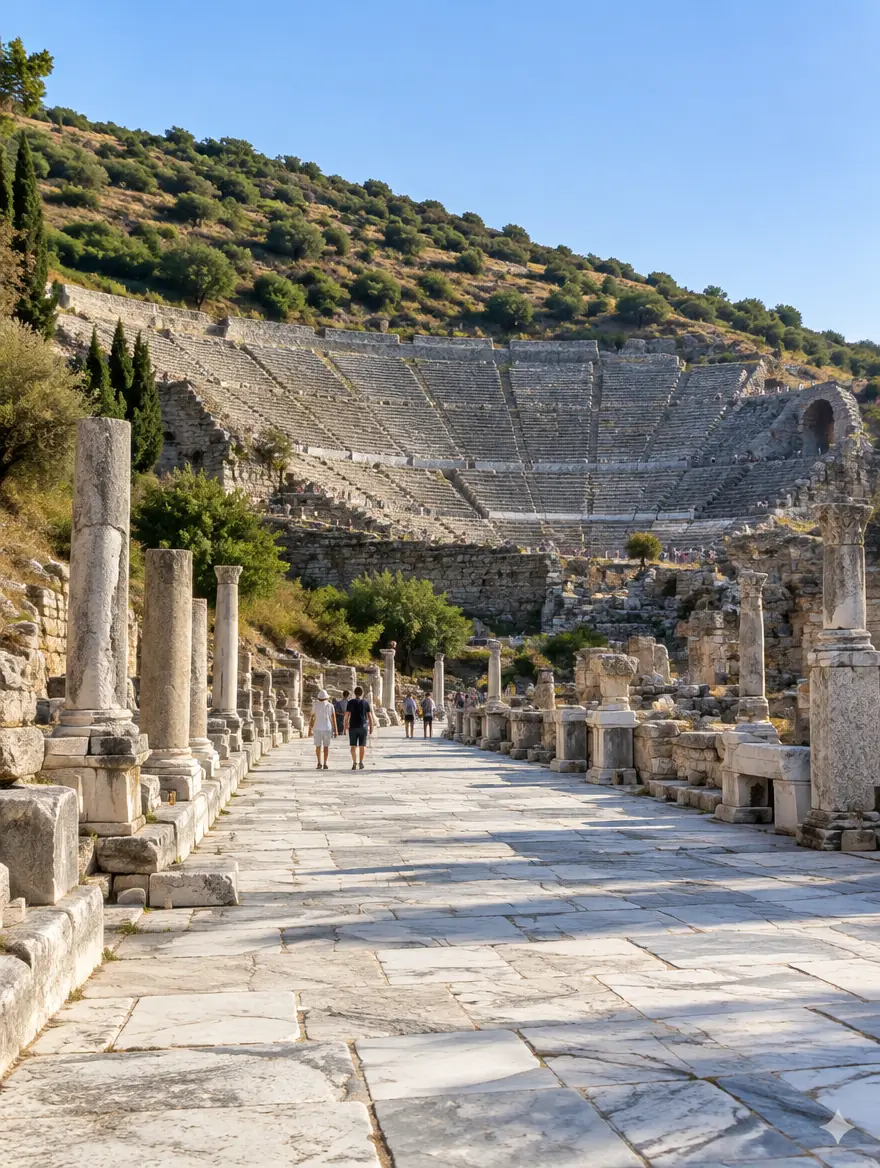
What you walk through today is mostly the Roman city: marble streets lined with columns, fountains, public toilets, shops and houses, climbing between two hills. Excavations have gone on for more than a century, and only part of the ancient city has been uncovered.
Ephesus has been on the UNESCO World Heritage List since 2015, together with the remains of the Temple of Artemis near Selçuk, one of the Seven Wonders of the Ancient World, of which a single re-erected column survives.
Getting there
How to get to Ephesus from Izmir
The simplest way is by car: the drive south on the motorway towards Selçuk takes around an hour from central Izmir, depending on your hotel and traffic. Your coordinator can arrange a driver for the day once your surgeon is happy for you to go.
Regional trains also run between Izmir and Selçuk; from Selçuk station a short taxi ride takes you to either entrance of the site. Check the timetable on the day, as departures are not frequent.
Ephesus has two entrances, the upper gate and the lower gate. Starting at the upper gate means the walk through the city is mostly downhill, which is easier if you are recovering.
Recover, then explore
Body contouring packages in Izmir with time to see Ephesus
Many body contouring patients plan a gentle day out near the end of their stay, once their surgeon has cleared them. Each package card shows the hospital and hotel nights it covers.

Tummy tuck

Liposuction

Thigh lift
What to see
Visiting Ephesus and what to see on the way down
A one-way walk from the upper gate to the lower gate covers the main sights. Allow longer if you add the Terrace Houses.
| Stop | What it is | Allow |
|---|---|---|
| State Agora and Odeon | The civic centre of the Roman city and a small roofed concert hall | about 20 minutes |
| Curetes Street | A sloping marble street with fountains, statues and the Temple of Hadrian | about 20 minutes |
| Terrace Houses | Roofed excavation of wealthy homes with mosaics and wall paintings (separate ticket) | about 45 minutes |
| Library of Celsus | The two-storey facade built in the 2nd century AD as a library and tomb | about 20 minutes |
| Great Theatre | One of the largest theatres of the ancient world, built into the hillside | about 20 minutes |
Times are a guide for a relaxed pace. Opening hours and tickets are set by the site; check them before you go.
Patients who stayed in Izmir
Tummy tuck and BBL reviews from patients who recovered in Izmir
1 / 3
Visiting Ephesus after surgery
Ephesus is a walk of two to three kilometres on worn marble, with slopes, steps and very little shade. Add an hour in the car each way and it is a full outing, which is why the timing matters more than for a stroll in Izmir.
Whether you can go, and when, depends on the treatment you had and on how you are healing, so ask your surgeon before you book a driver. After a BBL, for example, surgeons usually give specific advice on sitting, which affects a long car journey. Many patients see Ephesus on the day before treatment, or near the end of their stay once they have been cleared.
If you go, start early in the morning, enter at the upper gate so the route is mostly downhill, wear your compression garment if you have been told to, cover scars from the sun and carry water. Turn back whenever you feel tired; the site will still be there on a later visit.
Results vary from patient to patient. Your surgeon will tell you what is realistic for your recovery at the consultation.
Plan your days in Izmir
More day trips from Izmir
Back to the guide
Izmir travel guide
Airport, transfers, seasons and all four day trips.
Izmir travel guide →
Next stop
House of the Virgin Mary
A stone chapel on Mount Koressos above Ephesus.
Next stop: House of the Virgin Mary →
Day trip
Ancient City of Pergamon
Hilltop acropolis and the Asklepion healing centre.
Ancient City of Pergamon →
Day trip
Şirince Village
Stone houses and fruit wines in the hills above Selçuk.
Şirince Village →Questions
Ephesus questions from patients
How far is Ephesus from Izmir?
Ephesus is about 80 km south of central Izmir, near the town of Selçuk. The drive takes around an hour by car, depending on traffic and where you are staying.
How long do you need at Ephesus?
Two to three hours is enough to walk from the upper gate to the lower gate and see the main sights. Add around 45 minutes for the Terrace Houses.
Can I visit Ephesus after a tummy tuck or BBL?
It depends on your treatment and on how you are healing, so ask your surgeon first. The visit involves a long car journey and a walk on uneven ground; many patients go before surgery or at the end of their stay.
BBL with liposuction guide →Is Ephesus a UNESCO World Heritage Site?
Yes. Ephesus has been on the UNESCO World Heritage List since 2015, together with the Temple of Artemis and other sites around Selçuk.
What is the Library of Celsus?
It is the two-storey marble facade at the foot of Curetes Street, built in the 2nd century AD as a library and as the tomb of the Roman senator Celsus. It is the most photographed building at Ephesus.
Your trip to Izmir
Plan your treatment in Izmir and a day at Ephesus
Send your photos and a few lines about your health. A coordinator replies with a suggested plan, the dates available and when a day trip could fit into your stay.
Free consultation
Get your free quote from JFS Clinic
Tell us about the treatment you are considering and share a few photos. A coordinator replies with a personal plan, free of charge.
+90 555 420 45 05- 1 About your treatment
- 2 A bit more about you
- 3 How to reach you
- 4 Your free quote